
Stop Collecting Partners. Start Building an Ecosystem.
Most partner programs fail not from lack of partners, but from lack of fit. Here's how to choose the ones worth building with.
Telma Rafael
7/21/20264 min read


How to choose the right partners for your partner ecosystem
A strong partner ecosystem can accelerate growth, extend your product's reach, and unlock capabilities you'd never build alone. A weak one drains resources, confuses customers, and quietly damages your reputation. The difference almost always comes down to one thing: how deliberately you chose your partners in the first place.
Building a partner ecosystem isn't about signing as many logos as possible. It's about assembling a small, well-matched group of organisations that make your offering — and theirs — genuinely better together. Here's how to think about that process from the ground up.
Start with strategy, not a partner list
Before evaluating a single potential partner, get clear on why you're building an ecosystem at all — which starts with knowing your destination. Common goals include:
Filling capability gaps — offering something your customers need that you don't build in-house
Extending market reach — accessing new geographies, industries, or customer segments
Increasing product stickiness — integrations that make your product harder to replace
Accelerating go-to-market — leveraging a partner's existing customer relationships and trust
Each of these goals points toward a different kind of partner. A reseller who extends your reach in a new region looks nothing like a technology partner who deepens your product's integration surface. Get the "why" right first, and the "who" becomes much easier to filter for.
The core criteria for evaluating partners
Once you know what you're solving for, evaluate prospective partners against a consistent set of criteria. The strongest partnerships tend to score well across all of the following:
1. Strategic fit
Does this partnership move you toward a specific business goal, or does it just sound good on paper? A partner should close a real gap — in capability, geography, or customer access — not simply add another name to a partner page.
2. Complementary, not competing, value
The best partners solve a different piece of the customer's problem than you do. Overlapping offerings create channel conflict and internal competition for the same deal, which erodes trust on both sides.
3. Cultural, values, and customer-first alignment
Partnerships are relationships, and relationships run on shared expectations. Look at how a potential partner treats customers, how they communicate, how they handle mistakes, and whether their pace and risk appetite match yours. Just as important: do their incentives point toward the customer's success, or toward their own short-term gain? Misaligned values show up in every joint meeting, every escalation, and every renewal conversation — usually at the worst possible moment.
4. Technical and operational compatibility
For technology partnerships especially, look under the hood. Is their architecture, data model, or platform actually compatible with yours? Do they have the engineering capacity to build and maintain an integration? A partner with great intentions but thin technical resources will stall out after the launch announcement.
5. Market credibility and customer trust
A partner's reputation becomes attached to yours the moment you announce the relationship. Check references, review customer sentiment, and look at how long-standing their other partnerships are. Longevity in their existing partnerships is often a better signal than size or brand recognition alone.
6. Commercial viability
Map out how value and revenue will actually flow. Is there a clear, fair model for referrals, co-selling, or revenue share? Partnerships without a credible commercial model tend to fizzle once the initial enthusiasm wears off, because neither side has a reason to keep investing.
7. Capacity to invest
A partnership is only as strong as both sides' willingness to resource it — dedicated people, marketing support, training, and executive attention. A partner who signs the agreement but never staffs it isn't really a partner.
A practical process for building your ecosystem
Step 1: Map your ecosystem needs
Identify the gaps in your value chain — technology, services, geography, industry expertise — and prioritise them against your strategic goals.
Step 2: Build a scorecard
Turn the criteria above into a simple weighted scorecard. This keeps evaluation objective and repeatable as your ecosystem grows, rather than relying on relationships or gut feel alone.
Step 3: Run a structured discovery process
Treat partner evaluation with the same rigor as hiring. Have structured conversations with multiple stakeholders on both sides, request references, and pilot the relationship on a small scale before committing broadly.
Step 4: Start with a pilot, not a full launch
Co-sell on a handful of deals, integrate with a limited customer set, or run a joint campaign in a single region. A pilot reveals operational friction — and genuine enthusiasm — much faster than a signed agreement does.
Step 5: Define success metrics upfront
Agree on what "working" looks like before you launch: pipeline generated, deals closed, integration adoption, customer satisfaction. Without clear metrics, it's nearly impossible to know when to double down or when to walk away.
Step 6: Formalise with clear governance
Once a pilot proves out, put a real partnership agreement in place — roles, responsibilities, escalation paths, and a regular cadence for reviewing performance together.
Step 7: Review and prune regularly
Ecosystems need maintenance. Revisit partner performance on a set cadence, and be willing to sunset relationships that aren't delivering value for either side. A smaller, high-performing ecosystem beats a large, unmanaged one every time.
The benefits of getting it right
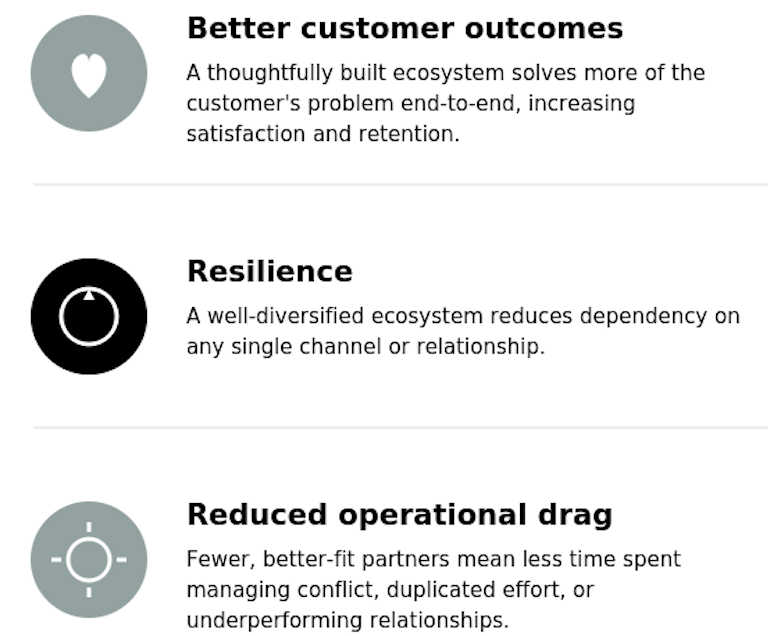
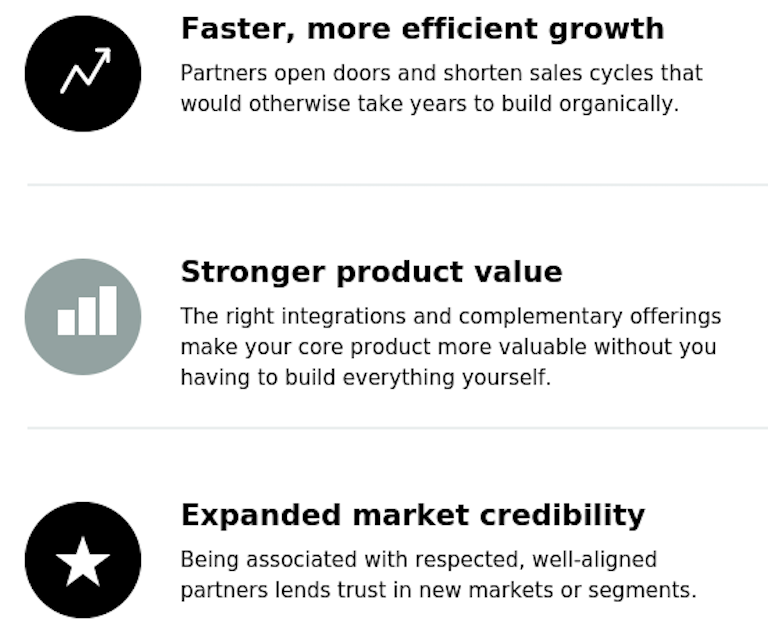
When partner selection is done well, the payoff compounds over time:
The bottom line
The organisations that build the most effective partner ecosystems aren't the ones with the most partners — they're the ones with the most intentional ones, built on a clear partner ecosystem strategy rather than opportunistic deal-making. Getting clear on strategy, applying consistent evaluation criteria, and treating each partnership as a relationship to be built deliberately (rather than a deal to be closed) is what separates ecosystems that create lasting value from ones that just create noise.
Choose fewer partners, choose them well, and invest in making each relationship succeed. That discipline is what turns a partner ecosystem into a genuine competitive advantage.